
SENDIG v4.0: What the Upcoming Changes Mean for 2026 Submissions

Introduction
As SEND becomes more established in regulatory submissions to the U.S. FDA, expectations are evolving beyond basic dataset standardization toward greater transparency, expanded domain coverage, and improved support for regulatory review.
With SENDIG v4.0 expected to be published in 2026, organizations preparing nonclinical submissions will need to adapt to a broader and more detailed set of requirements. These updates go beyond incremental changes and are likely to influence how data is structured, validated, and reviewed.
Understanding the implications of these changes early can help organizations better prepare for upcoming submission expectations.
SENDIG v4.0 is the upcoming version of the CDISC SEND Implementation Guide, introducing new domains, enhanced validation rules, and improved metadata requirements for regulatory submissions expected around 2026.
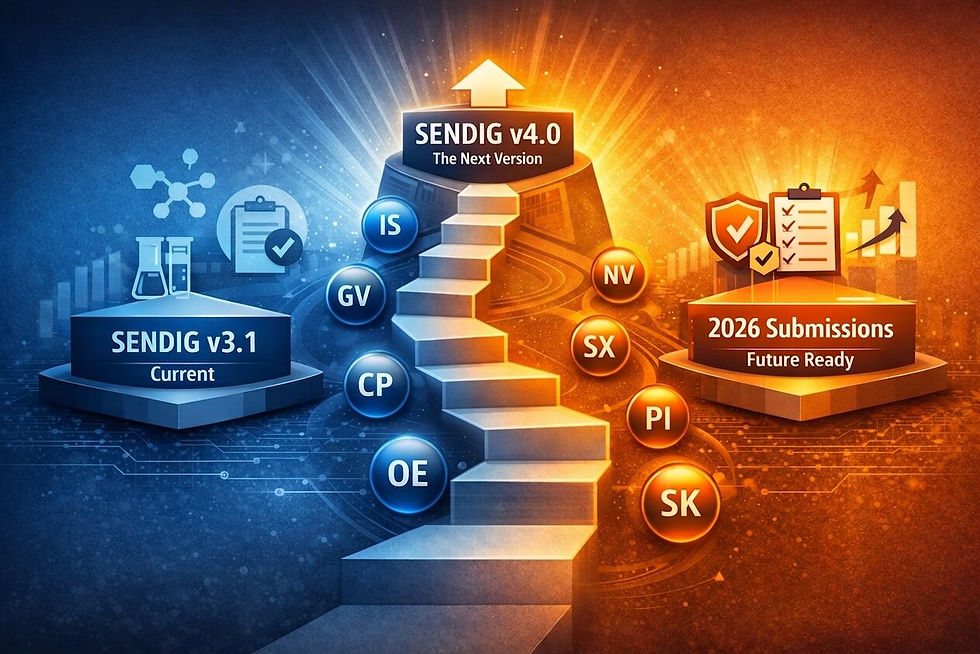
What Is Changing in SENDIG v4.0
SENDIG v4.0 builds on earlier versions, including SENDIG v3.1.1 and DART v1.1, introducing expanded scope, updated conformance rules, and enhanced metadata expectations.
1. Expanded Domain Coverage
The addition of new domains such as Cell Phenotyping (CP), Immunogenicity Specimen Assessments (IS), Ophthalmic Examinations (OE), Pharmacokinetic Input (PI), Scoring Scales (SX), Nervous System Test Results (NV), Skin Test Results (SK), and Genetic Toxicology – In Vivo (GV) reflects the need to standardize increasingly complex study endpoints.
In practice, this expansion may require:
Updates to existing data mapping approaches
Adjustments to data collection and study design considerations
Greater coordination across teams handling specialized data
2. Enhanced Conformance Rules
SEND Conformance Rules v4.0 introduce more rigorous validation expectations, with increased emphasis on:
Traceability between source data and SEND datasets
Consistent use of controlled terminology
Alignment across domains and datasets
These updates are likely to result in:
Stricter validation outcomes
Increased focus on inter-dataset consistency
Greater scrutiny during regulatory review
3. Increased Emphasis on Traceability and Metadata
SENDIG v4.0 places additional importance on metadata completeness and clarity, including refinements in variables related to age, race/ethnicity, and findings alignment.
This shift supports:
Improved reviewer understanding
Enhanced cross-study analysis
Greater transparency in regulatory submissions
What This Means for Organizations
While SENDIG v4.0 introduces clear advancements, it also brings additional considerations for organizations preparing for future submissions.
1. Greater Complexity in Data Preparation
Expanded domains and refined rules increase the level of detail required in dataset preparation, particularly for complex studies.
2. Need for Early Alignment
Changes in domain structure and metadata expectations may require alignment earlier in the study lifecycle, rather than at the point of submission.
3. Increased Validation and Review Effort
Stricter conformance rules are likely to result in more validation checks and a greater need for iterative review.
4. Impact on Existing Processes and Tooling
Organizations may need to evaluate:
Existing data pipelines
Mapping logic
Validation workflows
to ensure alignment with updated requirements.
Preparing for SENDIG v4.0
Given the expected timeline, early preparation can help mitigate risks.
Organizations may consider:
Reviewing proof-of-concept datasets and draft guidance
Assessing current processes against anticipated changes
Planning for updates to tools, workflows, and training
A structured approach can help ensure a smoother transition as regulatory expectations evolve.
Conclusion
SENDIG v4.0 represents a significant step forward in nonclinical data standardization, expanding both scope and expectations.
For organizations, the focus should not only be on understanding the changes, but also on evaluating how these changes impact existing processes, timelines, and submission readiness.
Early awareness and preparation will be key to navigating this transition effectively.


Comments